
Periods That Last: 10 Days, 15 Days Or More, What To Do?
Share
It's been bleeding for 10 days, or worse, 15, and you're starting to wonder if it will ever really stop. Beyond 8 consecutive days, it is statistically no longer within the normal range.And that warrants a proper consultation with a doctor, not just waiting any longer. But before you panic, know that the most common cause at any age remains a simple, benign hormonal imbalance, not a serious illness.
This guide directly answers the most frequently asked questions: periods that last 10, 15 days, or 3 weeks; periods twice a month; IUDs causing hormonal imbalances; and perimenopause. It provides the essential information to help you determine whether you should simply wait it out or consult a doctor.
A Quick Recap to Find Your Way Around
3 to 7 days.
Normal reference duration
8 days
Upper limit still acceptable, on occasion
10 to 15 days.
Often a hormonal imbalance, sometimes an IUD or perimenopause
3 weeks or more
This is probably no longer your period, but continuous abnormal bleeding.
1 to 2 days.
This can be normal for some women, or it may be related to hormonal contraception.
The True Definition of Normal
According to international gynecological guidelines, a normal menstrual period lasts between 4 and 8 days, with an average of around 5 days. The menstrual cycle itself typically lasts between 24 and 38 days. These are not arbitrary figures; they are part of the FIGO classification, used by gynecologists worldwide to distinguish a healthy cycle from one that warrants further medical attention.
The heaviest flow is usually concentrated in the first two to three days, then gradually decreases. A slight variation from month to month—four days this cycle, six days the next—is nothing to worry about in itself. It's a sustained departure from this range that should raise concern, not a small, occasional fluctuation.
10 Days, 15 Days, 3 Weeks: What's Really Happening
After eight days, menstruation moves beyond the realm of normal periods and into what doctors call prolonged menstruation, or even abnormal uterine bleeding if it significantly exceeds this limit. Several mechanisms can explain this, and age strongly suggests the most likely cause.
💡 A point that is often misunderstood When bleeding lasts for three weeks or a whole month, it's almost never a continuous menstrual flow. It's more often a sign of a missed ovulation, which allows the uterine lining to thicken without ever renewing itself normally, until it's shed irregularly and for an extended period. From a medical standpoint, it's no longer really "periods," it's abnormal bleeding that requires a diagnosis.
In a teenage girl, this type of prolonged bleeding is most often explained by an immature hormonal system; the very first cycles are frequently anovulatory. In an adult woman, the most frequent causes are a functional hormonal imbalance, a fibroid, a polyp, or a adenomyosisCertain medications, particularly anticoagulants, can also significantly prolong the duration of bleeding.
Is it serious to have periods twice a month?
Not necessarily. It all depends on the actual length of your cycle, not the number of times you see blood in a calendar month.
If your natural cycle lasts 21 to 24 days, it's perfectly normal to have two periods in a 30- or 31-day month without it being abnormal. It's simply a short cycle, an individual variation that affects a number of women. The real warning sign is when bleeding occurs repeatedly at intervals of less than 21 days, a condition known as polymenorrhea, or when extra bleeding appears in the middle of the cycle unrelated to the usual pattern.
The simple test Count from the first day of your last period to the first day of your next. If this number remains consistent from month to month, even if it's short, it's probably your natural cycle. If it varies significantly or shortens abruptly compared to usual, it's worth discussing it with a healthcare professional, especially if it's accompanied by a heavier flow.
IUD: Why Your Periods Have Changed Completely
This is one of the most common causes of completely irregular periods, and it depends entirely on the type of IUD inserted. Copper and hormonal IUDs have absolutely different effects on your bleeding.
Copper IUD
A study that followed users for 6 months measured an increase in flow in about 7 out of 10 women in the first few months after application, with a peak in the first month which then gradually decreases, without necessarily returning completely to normal for all.
Longer and heavier periods for 3 to 6 months after insertion are therefore expected. If this persists well beyond this period or becomes significantly debilitating, a consultation will allow for adjustments or consideration of another option.
Hormonal IUD (Mirena type)
The pattern is reversed but just as confusing at first. Spotting or irregular bleeding frequently occurs in the first 3 to 6 months, before periods become significantly lighter, or even disappear completely in some users.
Long-term data shows that after several years of use, about one-third of women no longer have periods at all, one-quarter have very spaced-out bleeding, and a small proportion continue to have irregular or occasionally prolonged periods.
⚠️ This falls outside the expected framework Very heavy periods that persist after 6 months, severe pain that worsens, or fever are not typical side effects of any type of IUD. This warrants a consultation to ensure the device is correctly positioned.
Premenopause: The Body Changes Rhythm Without Warning
If you are over forty and your periods are no longer what they used to be, perimenopause is a perfectly plausible explanation, often well before the first hot flashes.
The main mechanism is anovulation, which becomes more frequent as the ovaries become less responsive to hormonal signals. Without regular ovulation, the uterine lining thickens in a less controlled manner, which can lead to longer, heavier periods, or conversely, cycles that become much less frequent. There is no single scenario; the same body can alternate between a month of very light periods and the following month of bleeding that lasts for 10 days.
This transition phase lasts on average 4 to 7 years before definitive menopause. Your irregular periods bleeding during this period does not automatically mean there is cause for concern, but regular gynecological monitoring is still recommended to rule out other causes, especially if bleeding becomes really heavy or if contraception remains necessary, since pregnancy is still possible as long as periods have not disappeared for a full year.
Appropriate Protection, Whatever the Duration
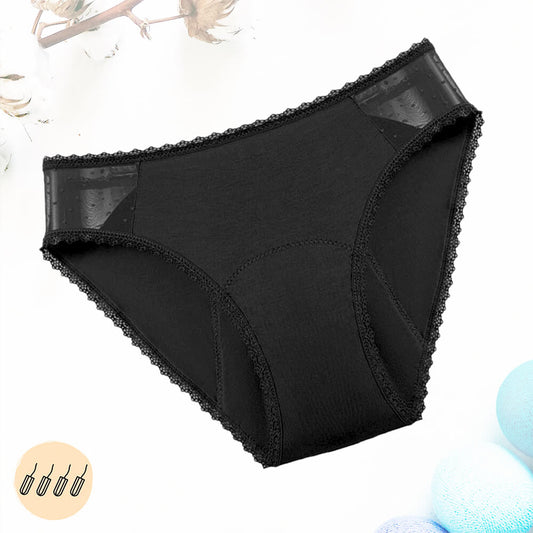
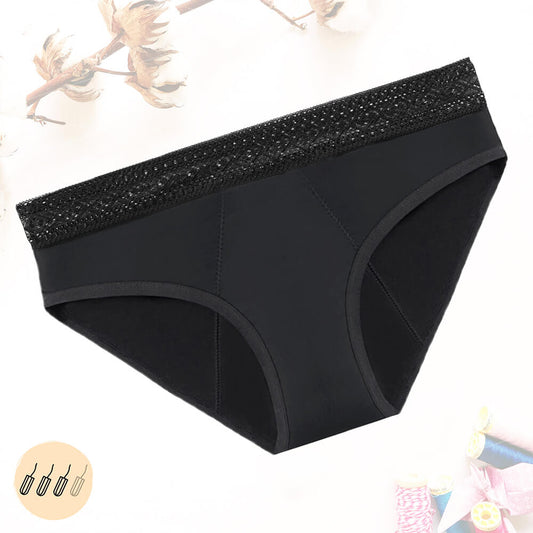
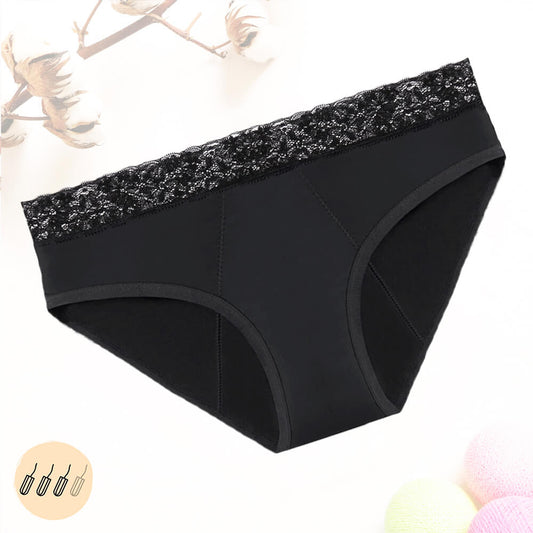
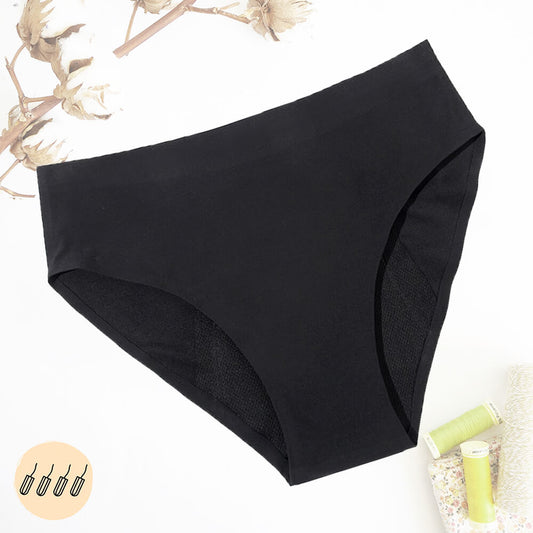
Unpredictable cycles, extended periods, flow that changes from day to day, our period panties adapt to all situations without forcing you to guess in advance.
What if your period only lasts 1 day?
At the other extreme, very short periods are just as worrying, even though they are often much less problematic than excessively long periods.
With hormonal contraception, postpartum, or during perimenopause, periods reduced to one or two days are common and rarely a cause for concern. What is known as hypomenorrhea can also be a lifelong, stable individual characteristic, unrelated to fertility problems. Our guide on...hypomenorrhea oftaille the possible causes and when it warrants medical advice.
Bleeding 15 days after your period is probably not your period.
If blood appears about ten or fifteen days after the end of your last period, there is a good chance that it is ovulation spotting, a light spotting that occurs in some women around the middle of the cycle, due to the temporary drop in estrogen at that precise time.
The distinction is easily made based on appearance, this mocking It is usually light, pinkish or brownish, and rarely lasts more than a day or two, unlike a true period. If this bleeding becomes heavier, requires regular sanitary protection, or recurs systematically with each cycle, a consultation will help rule out other causes such as a polyp or a hormonal imbalance.
The Signal That Should Really Make You React
Amid all these possible variations, some signs warrant a consultation rather than prolonged observation at home.
Changing sanitary protection every hour for more than two consecutive hours, bleeding that repeatedly lasts more than 8 days over several cycles, a flow so heavy that it soaks through clothing, intense fatigue or dizziness suggestive of anemia, or any bleeding after menopause, are all reasons to consult a doctor without delay. Our heavy period test helps to objectify the issue of flow in a few minutes.
In all other cases, an isolated and moderate change does not necessarily justify urgency, but deserves to be noted to be discussed at your next gynecological appointment, especially if it becomes your new usual rhythm.
Frequently Asked Questions
I've had my period for 10 days, is that normal?+
No, statistically it's no longer within the normal range, which is generally limited to a maximum of 8 days. It's not necessarily serious; the most frequent cause remains a benign hormonal imbalance, but it's worth discussing with a doctor rather than waiting for it to resolve on its own, especially if the flow remains heavy.
My period has been going on for 3 weeks, what should I do?+
See a doctor promptly. Such prolonged bleeding is almost never a continuous menstrual flow; it's more likely abnormal uterine bleeding related to a lack of ovulation, a fibroid, a polyp, or a hormonal imbalance, which requires a thorough evaluation. The longer it lasts, the greater the risk of anemia, so it's best not to delay seeking medical attention.
Is it normal to have your period twice a month?+
Yes, if your natural cycle lasts between 21 and 24 days, having two periods in a calendar month is perfectly normal. What should concern you is an interval that repeatedly becomes shorter than 21 days, or a pattern that changes abruptly from your usual routine.
Does the copper IUD permanently make periods longer?+
Not necessarily permanent, but not always completely reversible either. Studies show a significant decrease in flow between the first and sixth months after insertion, without it systematically returning to the exact previous level for all users. If the increase remains manageable, it's not a sign of a problem. If it becomes bothersome after several months, a consultation will allow you to consider other options.
Why have my periods been changing so much for the past few months without any apparent reason?+
Several factors are possible depending on your age and circumstances: a change in contraception, significant stress, weight fluctuations, the approach of perimenopause if you are in your forties, or, more rarely, a thyroid disorder. If none of these seem to explain the change, or if the new periods are significantly impacting your daily life, a consultation can provide a clearer understanding with a tailored assessment.
Your Pace Matters More Than Average
Three to seven days remains the standard reference point, but your own usual rhythm matters more than any theoretical average. What should really concern you is a clear and lasting change from what has always been normal for you, not an isolated variation from one cycle to the next. Beyond eight days, or if you're experiencing a flow that's exhausting you, consulting a doctor remains the simplest way to turn concern into a concrete solution.
Sources & References
- Munro MG, Critchley HOD, Fraser IS, FIGO Menstrual Disorders Committee. (2018). The two FIGO systems for normal and abnormal uterine bleeding symptoms and classification of causes of abnormal uterine bleeding in the reproductive years: 2018 revisions. International Journal of Gynecology & Obstetrics. DOI: 10.1002/ijgo.12666
- Sanders JN, Adkins DE, Kaur S, et al. (2018). Bleeding, cramping, and satisfaction among new copper IUD users: A prospective study. PLoS ONE. DOI: 10.1371/journal.pone.0199724
- Menstruation in Girls and Adolescents: Using the Menstrual Cycle as a Vital Sign. American College of Obstetricians and Gynecologists (ACOG). ACOG
- Heavy and Abnormal Periods. American College of Obstetricians and Gynecologists (ACOG). ACOG
- Mirena (levonorgestrel-releasing intrauterine system): bleeding data. Manufacturer's clinical data, multicenter randomized controlled trial. Mirena HCP
- The menstrual cycle. MSD Manual for the General Public. MSD Manuals