
Ovulation Spotting: Why It Doesn't Predict Anything About Your Fertility
You've noticed a small pinkish spot in the middle of your cycle, neither during your period nor before, and you're wondering if it might be a sign that you're particularly fertile this month. It's tempting to believe, and even some health websites leave room for doubt. But science says something elseThis spotting doesn't predict anything about your chances of getting pregnant that cycle. It just happens to occur at the same time as your ovulation, and it's not a more reliable sign than any other.
We explain why this slight bleeding exists, what it really reveals about your hormones, and above all what you should observe instead if you really want to identify your fertile window, whether you are trying to get pregnant or are looking to avoid it.
💡 The Essentials in 30 Seconds
Why We Get the Impression That This Is a Good Sign
The idea stems from a real but misinterpreted observation. Several studies have indeed noted that women who experience spotting mid-cycle have, on average, slightly higher levels of estrogen, progesterone, and luteinizing hormone around ovulation than those who don't. Logically, it's quickly deduced that more hormones equal greater fertility that month.
The problem is that this deduction doesn't hold up. No research has ever established a link between these slightly higher hormone levels and a higher conception rate. Spotting remains a side effect of the hormonal fluctuations of ovulation, not an indicator of the quality of that ovulation.

💬 What's really going on Just before ovulation, your estrogen levels spike and then plummet when the egg is released. This sudden drop can be enough to slightly destabilize the uterine lining, causing a few drops of blood to leak. This is a consequence of the process, not an indication of its quality.
What Does Normal Ovulation Spotting Look Like
If your bleeding falls outside this range—if it becomes heavy, lasts more than two days, or is accompanied by severe pain—it's probably no longer typical ovulation spotting. It's best to consult a doctor to rule out other causes such as an infection or a polyp.
The Signal You Should Really Watch Out For
Since only 5 to 13% of women experience spotting, and it doesn't reliably predict anything even for those who do, basing your fertility monitoring on this single indicator is mostly guesswork. There is a much more universal and accurate signal.
Cervical Mucus, The True Indicator
Unlike spotting, almost all women who ovulate normally experience a change in their cervical mucus. It goes from thick and sticky to clear, stretchy, and slippery, a bit like raw egg white, in the days leading up to ovulation.
How to observe it in practice
- Check every day at the same time, ideally before going to the toilet
- Note the texture over a few days: sticky, then creamy, then stringy, this indicates the approach of ovulation.
- The peak of stretchy cervical mucus usually occurs 1 to 2 days just before ovulation; this is your most fertile window.
This signal alone has shown, in several studies, a much better ability to predict fertile days than any spotting.
Ovulation Tests, To Confirm
If you want more precise confirmation than observation alone, urine test strips that detect the luteinizing hormone (LH) surge remain the most reliable and readily available method without a prescription. This surge occurs 24 to 36 hours before ovulation, which is the optimal time for intercourse if you are trying to conceive.
🥚 Everything You Need to Know About Fertile Cervical Mucus →
Ovulation Spotting or Light Implantation Bleeding
Two light bleeding episodes look similar and are easily confused, but they never occur at the same time in the cycle, which makes it quite easy to distinguish them.
- Ovulation spotting · occurs in the middle of the cycle, usually between day 11 and day 21
- Implantation bleeding It occurs 6 to 12 days after ovulation, therefore much closer to the expected date of menstruation, and signals that an embryo has just implanted.
If you notice spotting just before the date you expect your period rather than in the middle of your cycle, it is probably not related to ovulation but to something else, potentially a sign of early pregnancy.
Small Losses, Small Protection
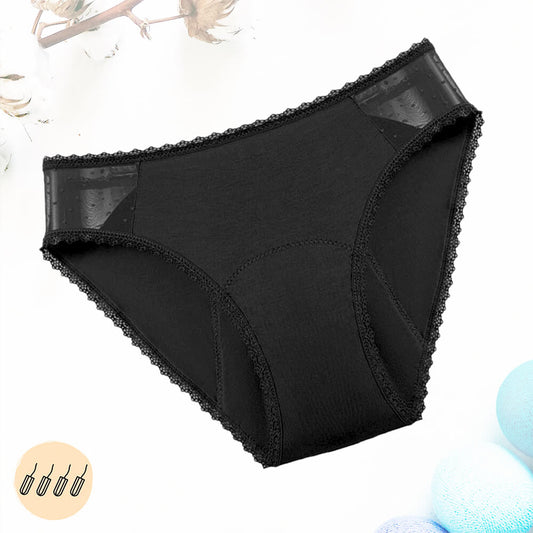
Whether it's ovulation spotting or a change in heavy cervical mucus, lightweight period panties absorb without the need to bother with a disposable panty liner every month.
You can drop this idea without worry.
Having or not having spotting mid-cycle doesn't change your actual chances of getting pregnant this month. This light bleeding is simply a normal consequence, sometimes visible, sometimes not, of the brief drop in estrogen that accompanies ovulation. If you really want to know where you are in your cycle, observe your cervical mucus day by day, or use an ovulation test for more precise confirmation.
And if you've never seen a single drop in your entire life, don't worry, the vast majority of women never have one and ovulate perfectly well.
Sources & Scientific References
- Dasharathy SS, Mumford SL, Pollack AZ, et al. (2012). Menstrual Bleeding Patterns Among Regularly Menstruating Women. American Journal of Epidemiology. DOI: 10.1093/aje/kwr356
- Najmabadi S, Schliep KC, Simonsen SE, et al. (2021). Cervical mucus patterns and the fertile window in women without known subfertility, a pooled analysis of three cohorts. Human Reproduction. DOI: 10.1093/humrep/deab049
- Bigelow JL, Dunson DB, Stanford JB, et al. (2004). Mucus observations in the fertile window, a better predictor of conception than timing of intercourse. Human Reproduction. DOI: 10.1093/humrep/deh173
- Harville EW, Wilcox AJ, Baird DD, Weinberg CR. (2003). Vaginal bleeding in very early pregnancy. Human Reproduction. DOI: 10.1093/humrep/deg374