
The True Weight of Your Periods Over a Year (What Nobody Calculates)
Not the "save the planet" version that's constantly being pushed on you, just your own calculations. How many sanitary products do you actually use over twelve months, what their actual weight is, and what difference it makes if you switch to period underwear for good.
No grand ecological speeches, just figures that concern you, specifically.
The Essentials to Remember
- A woman uses on average 10,000 to 15,000 disposable protective items throughout her entire menstrual life
- Menstrual products represent 13% of residual household waste in France according to ADEME
- The plastic they contain takes approximately 500 years to deteriorate
- Over the course of a year, that represents between 200 and 300 disposable sanitary products for a woman with an average flow.
- A single well-maintained pair of underwear can replace hundreds of these units over its lifespan.
Calculate Your Own Number
Take the number of sanitary products you use per day of your period, multiply by the usual number of days of your period, and multiply by 12 months. Most women go through between 200 and 350 sanitary products per year without even realizing it because it happens pack after pack.
📐 Concrete calculation
5 sanitary products per day of menstruation × 5 days of menstruation × 12 months = 300 protections per year, then to be multiplied by 35 to 40 years of menstrual life to obtain an order of magnitude over a full life, consistent with the 10,000 to 15,000 units generally cited.
Where Does This Plastic Really End Up
This isn't just a figure of speech; it's official data. Disposable menstrual products account for 13% of residual household waste in France, alongside diapers and wipes, according to figures from ADEME (the French Agency for Ecological Transition). The plastic they are made of, even in pads that appear "cotton" on the surface, takes approximately 500 years to decompose once buried.
What a Single Pair of Underwear Changes
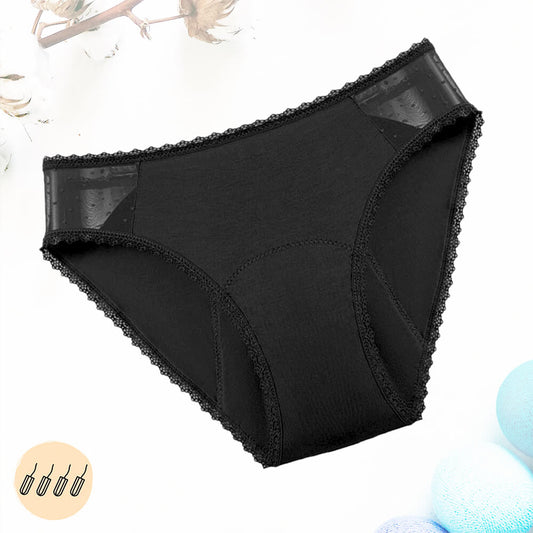
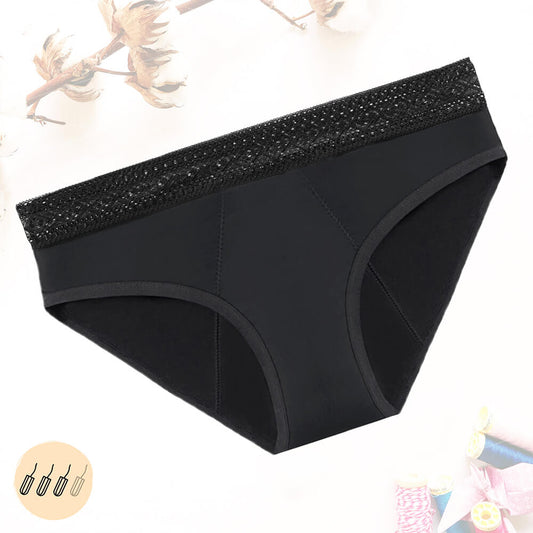
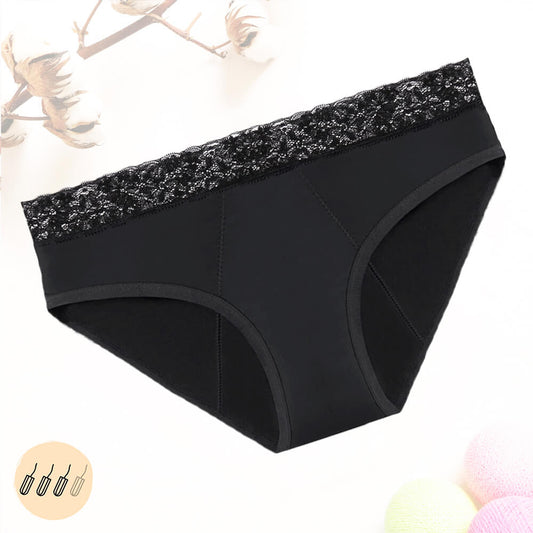
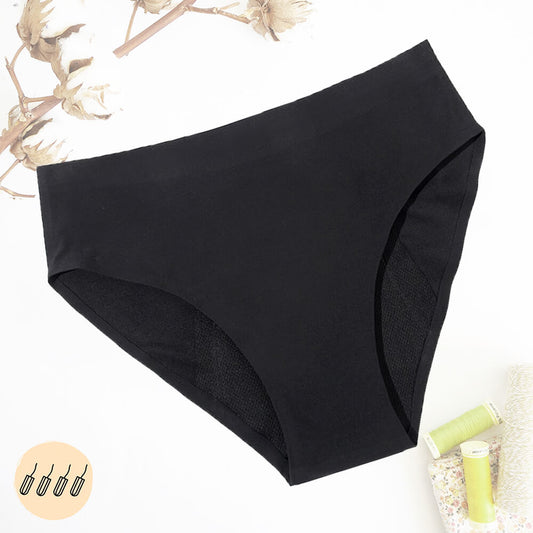
A properly cared-for period panty lasts 3 to 5 years. During this time, it replaces several hundred disposable menstrual products, without any of them ending up in landfills or incinerators. A stock of 5 to 7 panties is enough to cover a complete cycle without ever having to resort to disposables.
A point of honesty that we don't hide from you

Switching to washable products clearly reduces the volume of waste thrown away, but it is not a 100% "zero impact" gesture, and it is better to say this clearly rather than selling an overly perfect image.
A recent environmental science study has shown that reusable menstrual products, including underwear, can also release small amounts of plastic additives during washing, particularly those with a synthetic waterproof layer. This isn't a reason to go back to disposable products, whose long-term environmental impact remains significantly greater, but it is a good reason to choose brands that are transparent about the exact composition of their products and to wash them at low temperatures rather than hot ones.
This Choice Goes Beyond Your Own Bathroom
Reducing menstrual waste also has a rarely discussed social dimension. In France, millions of women cannot afford to buy menstrual products every month. Donating reusable menstrual products allows for concrete action on this issue, in addition to the individual environmental benefit.
Understanding Period Poverty →
Frequently Asked Questions
Do the calculation once, you won't forget it again.
300 protections per year isn't some abstract environmental campaign statistic; it's probably close to your own figure. Once you see it in black and white, it's hard to continue thinking of it as a minor detail.
Sources & References
- French Agency for Ecological Transition (ADEME). Data on the proportion of menstrual products in residual household waste, cited by Zero Waste France
- Environmental Science & Technology. Plastic Additives in Single-Use and Reusable Menstrual Products, Potential Implications for Human Health and the Environment. ACS Publications