
Labia Pad: The Zero Waste Protection You Don't Yet Know About
Have you ever experienced that unpleasant sensation of your period leaking up your buttocks during the night, or that leak on the side of your pad despite using a pad that's supposed to last all day? There's a little-known pad, almost never advertised on store shelves, that addresses this exact problem. The interlabial petal It does not replace your usual protection, it reinforces it where it most often fails.
We explain to you what it is in concrete terms, how to use and maintain it properly, and above all in which specific situations it really makes a difference compared to your other protections.
💡 Key Takeaways
What exactly is the interlabial petal?
Imagine a cross between a tampon and a sanitary napkin, except it's never inserted inside the vagina. The interlabial petal, also called an interlabial pad or labia pad, is a small piece of absorbent fabric shaped like a petal or leaf, which slips directly between your labia, right at the entrance of the vagina.
Held in place naturally by your lips, it intercepts menstrual flow at the point of exit, before it even has a chance to flow onto your pad or back up elsewhere. Made of cotton or another breathable fabric, it comes as a simple rectangle that you roll or fold into the shape that suits you best.

The Important Nuance
Depending on the model, absorption capacity varies from 2 to 10 ml depending on the manufacturer, which is equivalent to one or two tampons. This is intentionally limited; its purpose is not to absorb your entire flow but to manage a specific area that other menstrual products don't cover well.
Situations Where He Really Makes a Difference
It's clearly not the most well-known form of protection, and for good reason: it never replaces primary protection. But in certain specific cases, it's exactly the solution that was needed.
💧 Redirecting a flow that gushes rather than flows
Some days, your flow doesn't come out smoothly; it comes out in spurts. A regular pad sometimes doesn't have time to absorb before it overflows. Placed directly at the opening, the petal slows down this flow and gives your main protection time to absorb properly.
🛏️ Prevent leaks towards the back at night
When lying down, your flow naturally tends to flow up towards your buttocks rather than forwards, the classic scenario of waking up with a stain on the sheet. The petal prevents this by intercepting it directly at the source.
🩹 Extra security with a tampon or cup
If you use a tampon or menstrual cup and are worried about occasional leaks, the petal acts as a more effective panty liner, without the drawbacks of plastic.
🌸 Minor, occasional urinary incontinence
In cases of coughing, sneezing, laughing, or after pregnancy, some women experience minor urinary leakage. The petal, properly positioned to cover the urethra, can absorb these small amounts daily.
Why It's Actually Good For Your Intimate Health

The fact that the interlabial petal remains outside the vagina, unlike a tampon or a cup, changes quite a few things in terms of health.
- The risk of toxic shock syndrome is very low. This rare but serious infection is primarily associated with internal protective measures left in place for too long; the petal largely escapes this risk.
- Less risk of urinary tract infection Without prolonged direct contact inside the vagina, the risk of vaginal flora imbalance decreases.
- Reduction of excess humidity Unlike a plastic panty liner that traps heat, breathable fabric helps limit the growth of fungi
⚠️ An honest nuance While this risk is reduced, it is not eliminated, especially if the pad is worn for too long without being changed or used with insufficient hygiene. Always adhere to the recommended change interval, regardless of the type of protection chosen.
How to Put It On Correctly
- Fold the petal in half lengthwise; this is the most common and simplest fold to start with.
- Place it directly between your lips, at the vaginal opening.
- For use against urinary incontinence, make sure it covers the urethral area well.
- Don't hesitate to try different folding techniques over time; what works best varies considerably from one body type to another.
One important detail to know: you must remove your urinary swab before urinating, and be careful not to accidentally drop it in the toilet bowl. Remember to carefully replace it once you're finished.
Maintenance: To Make It Last and Remain Effective
Avant-garde use
Wash your cotton pad several times before using it for your period. Natural cotton needs about 5 washes to reach its maximum absorbency; it's normal if it seems less effective at first.
After each use
Rinse it quickly in cold water until the water runs clear; this prevents stains from setting in. Then store it in a waterproof bag if you're not at home, and then machine wash it with your regular laundry, ideally in a mesh bag to protect it.
Change frequency
Every 4 to 6 hours, or as soon as it reaches its maximum capacity, exactly like a regular towel.
One thing to note: if you have a light flow or wear it for a long time, the highly absorbent fabric can sometimes slightly dry out your skin. If you experience this, lightly dampening the pad before applying it may solve the problem.
How many do you need?

It entirely depends on how you use it. To manage your period with regular changes, about ten petals will last you around three days without needing to do another wash. If you only use them occasionally for vaginal discharge or light urinary incontinence, two a day is more than enough.
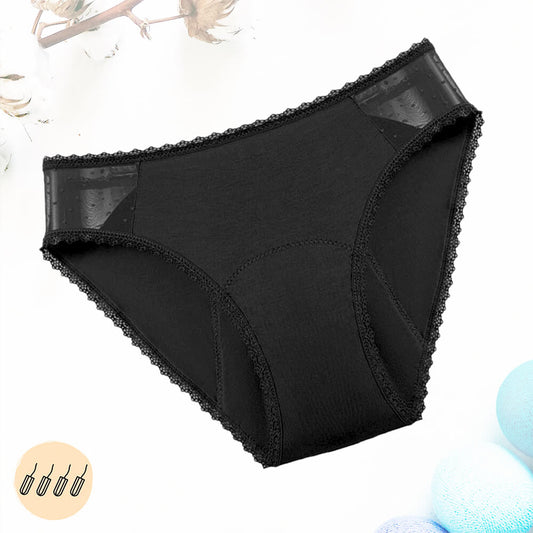
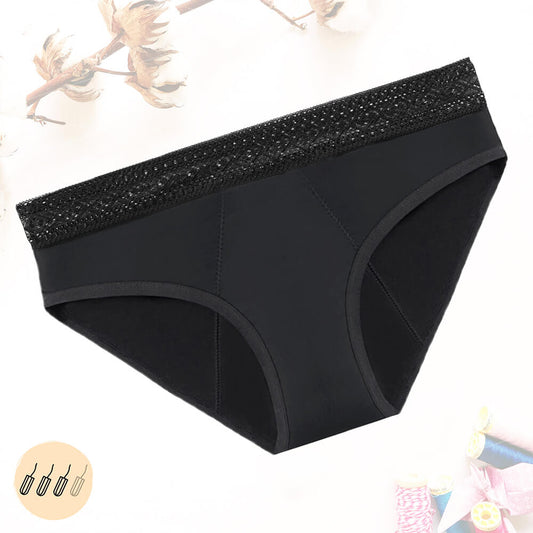
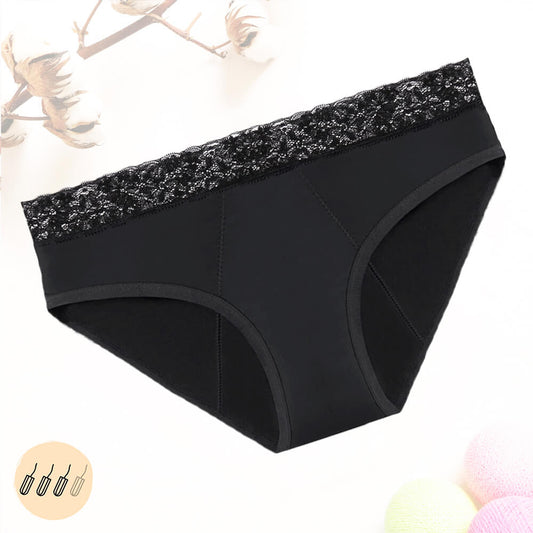
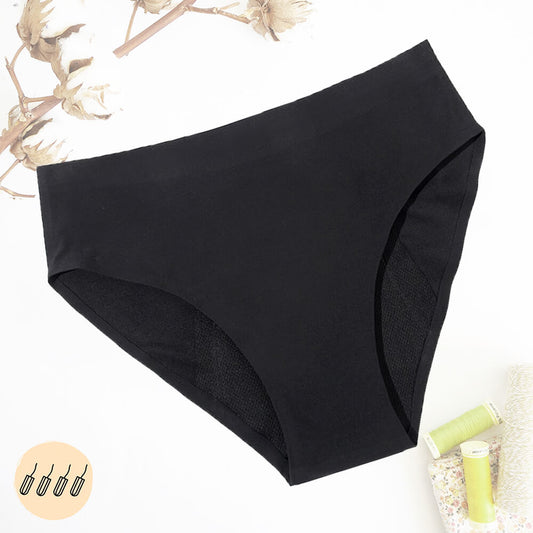
If you realize that you need real absorbency on a daily basis rather than just a supplement, menstrual underwear remains the most suitable option to cover your entire flow without juggling between several protections.
The Winning Duo Against Leaks
Combine your interlabial petal with menstrual underwear for complete protection, without plastic, without waste, and without the slightest leak, even on the most unpredictable days.
A Little Protection for a Big Relief
The interlabial petal will probably never be the most well-known protection on the market, but it solves a very specific problem that many women encounter without ever having found a suitable solution: leakage and stains upon waking. Economical, reusable, and generally gentler on intimate health than a traditional internal pad, it clearly deserves a place in a period routine, as a complement rather than a replacement.
Give it time for a few washes before judging its effectiveness, and don't hesitate to experiment with different folding methods until you find the one that really suits you.
Sources & References
- Petitti DB, Reingold AL, Chin J. (1986). Risk factors for menstrual toxic shock syndrome, results of a multistate case-control study. JAMA. PubMed: 2928651
- DeVries AS, Lesher L, Schlievert PM, et al. (2011). Staphylococcal Toxic Shock Syndrome 2000-2006, Epidemiology, Clinical Characteristics, and Molecular Characteristics. PLoS ONE. PMC3157910
- Schlievert PM, Davis CC. (2020). Device-Associated Menstrual Toxic Shock Syndrome. Clinical Microbiology Reviews. DOI: 10.1128/cmr.00032-19