
Cunnilingus During Menstruation: Yes, But With Some Precautions
Share
Many articles on the subject claim that the risk of STIs is no higher during menstruation. The scientific literature is more nuanced. Contact between the mouth and blood is a documented route of transmission for certain infections.These include HIV, HPV, and potentially hepatitis C, although this risk remains generally low compared to other sexual practices. A review published in the International Journal of Epidemiology confirms that the risk exists but remains difficult to quantify precisely, justifying caution rather than alarm.
This doesn't mean you should give up this practice every month. It means the decision deserves to be made with accurate information, neither minimized nor exaggerated. What the studies actually say, how to protect yourself practically, and how to manage the flow without constantly thinking about it.
A detail that changes everything
The clitoris, the center of pleasure during cunnilingus, is not the source of blood flow. The risk does not come from the area being stimulated, but from contact between the mouth and the blood that can flow around it.
What the Studies Really Show
A landmark review published in 1998 in Sexually Transmitted Infections analyzed all the available literature on viral transmission via the oral-genital route. Its findings remain the basis of current knowledge on the subject, supplemented since then by more recent and precise studies on specific viruses.
For HIV, this review reports documented cases of transmission from female to oral sex, in addition to the already known penis-to-oral transmission. A more recent systematic review, published in 2008 in the International Journal of Epidemiology, attempted to precisely quantify this risk based on ten available studies. Its conclusion is unequivocal: the risk of HIV transmission through oral sex is not zero but remains much lower than that of vaginal or anal penetration, and the existing data do not allow for a precise quantification. The authors themselves recommend the use of condoms or dental dams to limit this risk. It is precisely this uncertainty that leads public health recommendations to remain cautious rather than reassuring.
| Infection | What studies show |
|---|---|
| HIV | Transmission documented by reported cases, risk by contact low but not zero, difficult to quantify precisely. |
| HPV | The risk is low but established for the person performing cunnilingus, regardless of the rules. |
| Hepatitis C | Transmission is possible but rare; viral RNA is detectable in saliva with an infectious capacity considered low. |
| Herpes (HSV-1) | Established risk factor for the person receiving cunnilingus, transmitted via saliva independently of blood. |
| Syphilis | Documented transmission by contact with a lesion, probability estimated at around 1% per act in some studied cohorts. |
This table is not meant to frighten, but to put things into perspective. Most of these risks exist regardless of menstruation, except for HIV, where blood contact remains a recognized aggravating factor. In a relationship where both partners are tested and exclusive, this risk becomes marginal. It is primarily outside of this context, or without recent testing, that it becomes significant.
The Dental Dam: A Protective Device That Exists But Is Poorly Understood
A condom protects during penetration, but most people don't spontaneously think of anything similar for oral sex. That's precisely the role of a dental dam, a square of latex or polyurethane placed over the vulva during cunnilingus to prevent any direct contact between the mouth and blood or mucous membranes.
It can be found in pharmacies, some sexual health centers, online, or in adult stores. It can also be made from a regular condom by cutting off the tip and then opening it lengthwise to create a latex rectangle. Once inserted, a drop of water-based lubricant between the vulva and the dam enhances sensation and helps keep it in place.
💬 Don't panic if it doesn't work the first time
Several women who have tried it find that it reduces sensation or doesn't stay in place well, especially the homemade version. A dam specifically designed for this purpose, thinner and wider, generally gives better results than the makeshift version. Like the condom in its early days, it also has its share of social awkwardness to overcome; talking about it beforehand is perfectly normal.
Without a dental dam, a few precautions reduce the risk.
If a dental dam is not an option, some simple steps at least reduce the aggravating factors, even if they do not eliminate the risk related to the blood itself.
Avoid aggressive brushing just before or after Brushing teeth, flossing, or using mouthwash in the hour before or after causes tiny gum bleeds that go unnoticed but open an additional door.
Report in case of visible oral lesions · a canker sore, gingivitis, or any other wound in the person practicing justifies waiting, regardless of the time of the cycle.
Get tested if you have any doubts · if unprotected oral sex has already taken place, testing remains the best way to remove any doubt, specifying to the healthcare professional that it was oral sex, so that they can also take a sample from the throat if necessary.
Managing the Flow Without Constantly Thinking About It
Once the question of risk has been clearly addressed, the practical aspect remains, which is often more of a concern than health itself. Several options allow you to enjoy the moment without monitoring your every move.
A tampon or menstrual cup contains the flow inside the vagina while stimulation remains focused on the clitoris, which isn't the area where blood flows anyway. A shower is another simple option; the running water washes everything away immediately, allowing for intimacy without any conscious effort. For those who prefer to stay in bed, a dark towel placed under the pelvis avoids the worry of stained sheets without spoiling the moment.
The flow also varies throughout the day, generally being lighter in the morning after a night lying down. While the idea of blood may still be a real obstacle, it's not a problem that needs to be solved at all costs; there are other solutions. ways to maintain intimacy during menstruation which are equally suitable, from the masturbation to prolonged foreplay.
To Stay Calm During Your Period
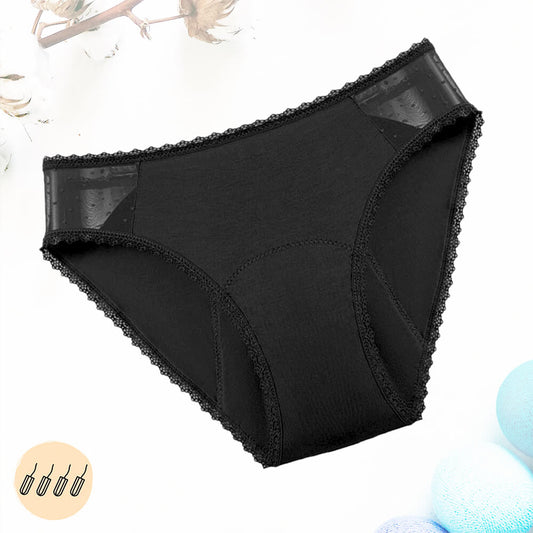
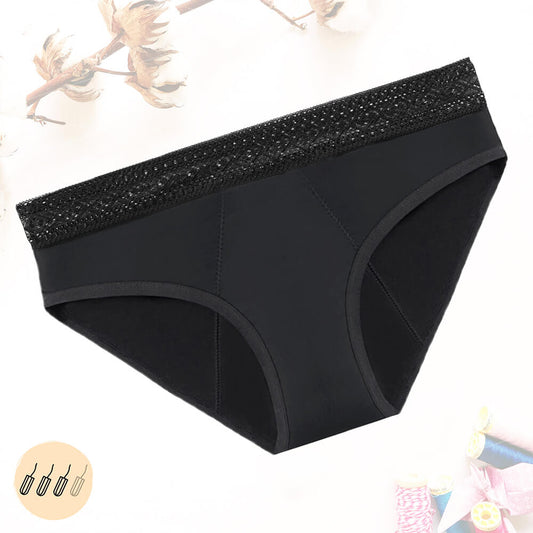
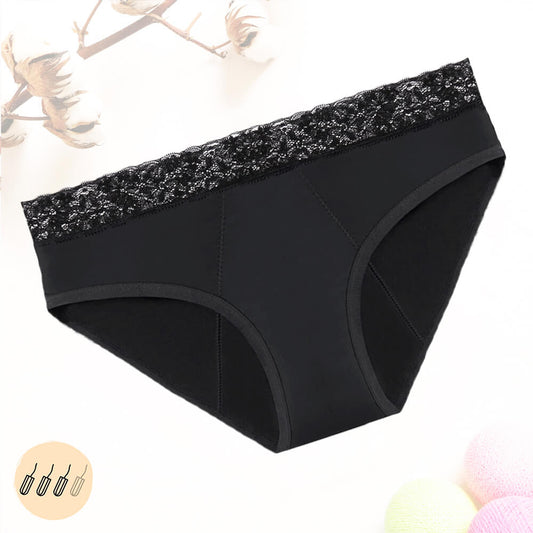
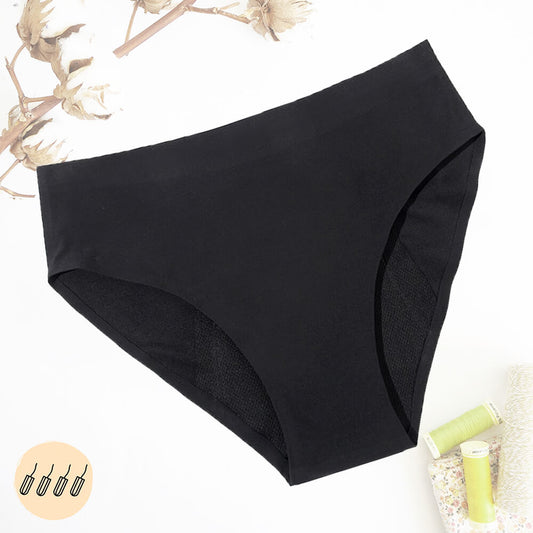
Our period panties absorb menstrual flow without compromising privacy, day or night. Comfortable, discreet, and suitable for all situations.
Why Blood Also Changes the Vaginal Terrain
Regardless of whether or not oral sex is involved, menstrual blood naturally raises vaginal pH. A study published in BMC Microbiology measured that a healthy vaginal environment is normally maintained at a pH of around 3,8, thanks to lactobacilli that produce lactic acid. During menstruation, these protective bacteria temporarily decrease, which explains why vaginal infections are sometimes slightly more common around this time, whether or not oral sex is involved.
In practical terms, this doesn't change the procedure for cunnilingus, but it explains why simple hygiene before and after intercourse remains useful, without going overboard with washing, which would further disrupt this balance already upset by menstruation itself. These variations also affect your libido, which naturally fluctuates with the cycle, not just during menstruation.
Frequently Asked Questions
In a stable and tested relationship, is it still necessary to use a dental dam?+
If both partners are in an exclusive relationship and have recently tested negative, the risk becomes very low. The studies cited above mainly concern situations of exposure with an infected partner or one of unknown status. Caution is particularly important at the beginning of a relationship or in situations where the serological status is not known with certainty.
Does the taste or smell of blood really change the experience?+
The sensation varies greatly from person to person; some barely notice anything, while others are bothered by the metallic taste of blood. Neither reaction is abnormal. If it's a real drawback, options for managing menstrual flow (tampons, menstrual cups, douches) limit this direct contact without preventing clitoral stimulation.
Is it possible to catch something even without any visible lesions in the mouth?+
That's entirely possible. Micro-lesions, for example those caused by brushing your teeth a little too vigorously or by sensitive gums, are often invisible to the naked eye, unlike a real cut or a canker sore. It's precisely for this reason that the absence of a visible lesion is not enough to guarantee the complete absence of risk.
Does oral sex during menstruation promote yeast infections?+
The risk stems primarily from the pH imbalance caused by the blood itself, not from cunnilingus. Simple hygiene with warm water before and after intercourse is perfectly sufficient; there's no need for harsh soap or vaginal douching, which would only worsen this temporary imbalance instead of correcting it.
A matter of information, not prohibition.
Oral sex during menstruation is not something to be avoided, but it's not entirely health-neutral either, contrary to what many articles suggest. With a dental dam, the risk becomes comparable to any other time of the cycle. Without one, in a stable and tested relationship, the risk remains low. It's primarily outside of this context that caution is warranted. The rest—taste, flow, presentation—is a matter of personal preference, not health.
Sources & References
This article is based solely on studies published in peer-reviewed scientific journals.
- Edwards S, Carne C. (1998). Oral sex and the transmission of viral STIs. Sexually Transmitted Infections. DOI: 10.1136/sti.74.1.6
- Baggaley RF, White RG, Boily MC. (2008). Systematic review of orogenital HIV-1 transmission probabilities. International Journal of Epidemiology. DOI: 10.1093/ije/dyn151
- Schmidt R, Carson PJ, Jansen RJ. (2019). Resurgence of Syphilis in the United States, An Assessment of Contributing Factors. American Journal of Men's Health. DOI: 10.1177 / 1178633719883282
- Ferreiro MC, Dios PD, Scully C. (2005). Transmission of hepatitis C virus by saliva? Oral Diseases. DOI: 10.1111/j.1601-0825.2005.01076.x
- O'Hanlon DE, Come RA, Moench TR. (2019). Vaginal pH measured in vivo, lactobacilli determine pH and lactic acid concentration. BMC Microbiology. DOI: 10.1186/s12866-019-1388-8